Best Family Hotels in Fukuoka — Kid-Friendly Stays Near Everything
Fukuoka's hotel market is built for business travelers, not families. OTA filters label anything with a third bed as a "family room" — including 18 m² units where three mattresses touch wall-to-wall. This guide cuts through that, ranking six hotels that actually work for two adults and one to three children, with connecting room availability, real m² data, and proximity to the attractions families care about.
Last updated: May 2026
Curated Google My Map — third-party cookies may be set by Google; see privacy policy.
Fukuoka is a city built for business travelers and transit efficiency — not for families hauling strollers, managing nap schedules, and searching for rooms where four people can actually sleep without stacking luggage in the bathroom. The OTA filter labeled “family room” does not help: Japanese hotel inventory categories make no distinction between a purpose-built 55 m² family suite and a 22 m² triple where three single beds have been pushed against three walls. This guide applies editorial judgment to that gap — six hotels, selected for room size, family amenities, neighborhood access, and transit to the attractions families actually want.
The short version
| Hotel | Largest room | Connecting | Pool | Family breakfast | Walk to subway | Off-peak price |
|---|---|---|---|---|---|---|
| Grand Hyatt Fukuoka | 85 m² (Japanese Suite) | Yes (request direct) | Yes (18+ mostly) | Full kids buffet | 4 min | ¥25,000–¥35,000 |
| Hilton Fukuoka Sea Hawk | 60 m² (Family Suite) | Yes (bookable online) | Yes (all ages, fee) | Kids buffet zone | 15–20 min | ¥18,000–¥28,000 |
| Solaria Nishitetsu Hotel Fukuoka | 35 m² (Deluxe Twin) | Yes (request direct) | No | Buffet + high chairs | 0–3 min | ¥16,000–¥25,000 |
| Hotel Monterey La Soeur Fukuoka | 22 m² (Triple Room) | No | No | Buffet | 4 min | ¥13,000–¥17,000 |
| JR Kyushu Hotel Blossom Fukuoka | 25 m² (Deluxe Twin) | No | No | Buffet + local produce | 2 min | ¥14,000–¥22,000 |
| Hotel Vista Fukuoka Nakasu Kawabata | 24 m² (Triple Room) | No | No | Buffet + kids pricing | 3 min | ¥10,000–¥16,000 |
What makes a Fukuoka hotel actually “family-friendly”
Japan’s hotel room size conventions differ from what most international travelers expect. A “standard” room in a Japanese business hotel averages 18–22 m². A “deluxe twin” at ¥20,000 per night might be 25 m² — smaller than a budget motel room in North America or Europe. Fire codes in many Japanese prefectures limit the official maximum occupancy of a room regardless of the physical bed count, which is why mid-range properties list “maximum 3 adults” for rooms that look spacious on paper.
Three practical rules apply when evaluating family hotels in Japan. First, connecting rooms are the correct answer for families of four with children over six — they provide guaranteed separation without paying suite prices. Second, Japanese hotels are not like resort hotels in Bali or Phuket: on-site children’s clubs and dedicated kids’ pools are rare outside the major resort brands. Third, location relative to subway elevators matters more in Japan than in almost any other city — a hotel five minutes from a fully step-free station is worth more to a family with a stroller than a marginally larger room that requires taxi rides.
The six hotels below score well on at least two of these three dimensions. None is a perfect score across all three — that trade-off is explained for each.
The luxury picks

Grand Hyatt Fukuoka
The five-star anchor inside Canal City Hakata — covered indoor access to a full shopping mall without crossing a single curb. The 85 m² Japanese-style tatami suite is the largest family room in this guide; standard twins run 34 m² with connecting configurations available on direct hotel request. Children 12 and under share beds at no charge, the most generous policy among the six properties. The Market F breakfast buffet provides high chairs, kids’ tableware, and a selection wide enough for picky eaters. Honest caveat: Club Olympus (25 m indoor pool) is adults-only outside narrow summer holiday windows — book Sea Hawk instead if pool access is non-negotiable. Demand note: Japanese Suite rooms sell out 3–4 months ahead for summer; confirm the connecting door request in writing immediately after booking.

Hilton Fukuoka Sea Hawk
The destination-resort option — and the only property in this guide where “resort” is not an exaggeration. Sotokoto Club pools (indoor + outdoor) welcome children at a daily fee of ¥1,000–¥2,000 per child unless staying in Executive rooms. Japanese-Western Family Suites at 55–60 m² include a tatami mat floor section for toddlers alongside a western bed section — a layout designed explicitly for families with mixed sleep preferences. Hilton’s site offers “Confirmed Connecting Rooms” booking, eliminating OTA uncertainty. Adjacent BOSS E·ZO Fukuoka (teamLab Forest, virtual coaster, rooftop slides) is a two-minute walk. Transit caveat: Tojinmachi Station is 15–20 minutes on foot — families staying here are committing to the Momochi waterfront zone. Demand note: Family Suites sell out on PayPay Dome event nights — check the dome calendar and book 2–3 months ahead for July–August.
The Tenjin core picks
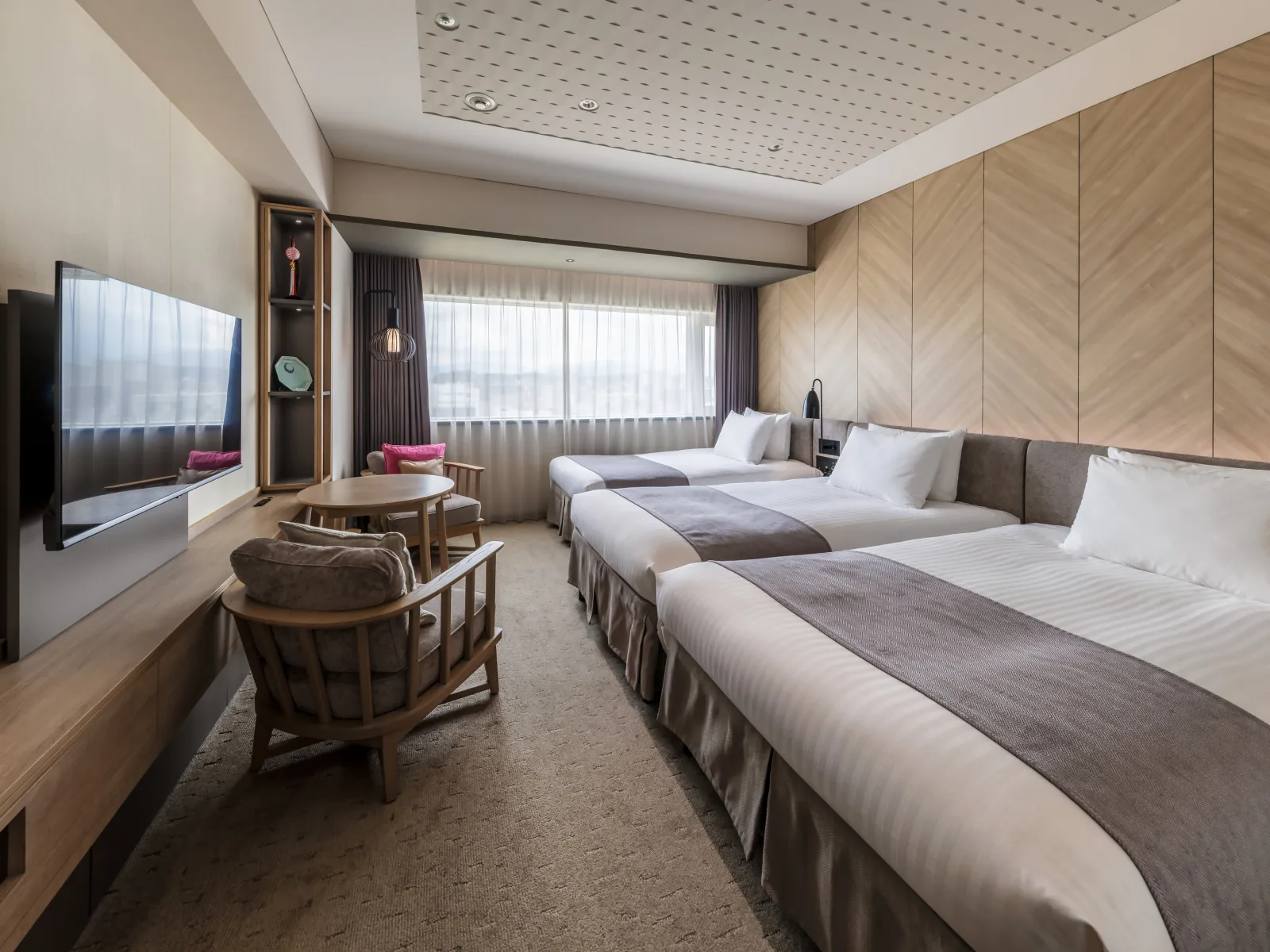
Solaria Nishitetsu Hotel Fukuoka
The hotel sits directly above Nishitetsu Fukuoka (Tenjin) Station with underground elevator connections to the subway, bus terminal, and Solaria Plaza — a family arriving with a stroller and two suitcases reaches the front desk without touching a single outdoor curb. Deluxe twins at 28–35 m² are above-average for Tenjin; connecting rooms available on direct request. The separated bathroom (deep Japanese soaking tub, toilet in separate room) is the top-cited family advantage in aggregate reviews for infant bathing. No pool or children’s club — the right choice when transit efficiency and shopping walkability outweigh resort amenities. Demand note: Upper-floor connecting configurations book first — confirm the request directly with the hotel at least 2 weeks out.

Hotel Monterey La Soeur Fukuoka
The dining-density pick for families. Located in Daimyo, four minutes from Tenjin Station, with hundreds of restaurants within a short walk. Triple rooms with three actual beds allow families of three to avoid a second-room cost. Hardwood floors in all 191 rooms are consistently cited as an advantage for crawling babies over standard hotel carpet. Trade-offs are real: Triple rooms at 22 m² leave no floor space once luggage is unpacked, and Daimyo alleys are congested with evening foot traffic after 19:00 — genuine stroller friction. No formal connecting rooms; adjacent requests honored when possible but not guaranteed.
The Hakata transit pick

JR Kyushu Hotel Blossom Fukuoka
Two minutes from Hakata Station’s Chikushi-guchi exit on flat, stroller-friendly pavement — the locational case is straightforward. Families on a Kyushu Rail Pass combining Fukuoka with Yufuin, Kumamoto, or Beppu reduce transit friction substantially. Breakfast sources Kyushu-local ingredients; Booking scores of 9.0 across 500+ reviews reflect clean rooms and reliable service. Hard limits for families: no connecting rooms, no extra beds, maximum occupancy two adults plus bed-sharing preschoolers. For families with a school-age child (7+), a second room is required — at that point Solaria’s connecting configuration may be the better total-cost calculation.
The mid-budget pick
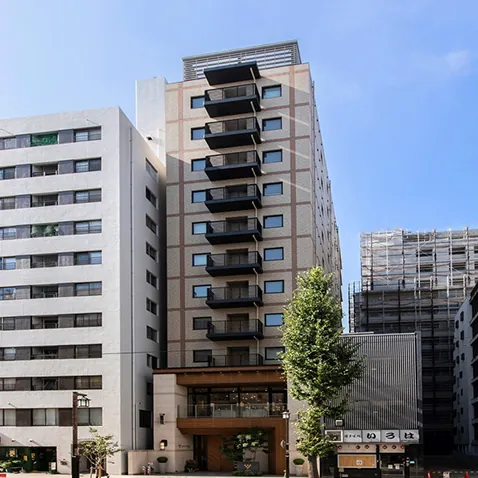
Hotel Vista Fukuoka Nakasu Kawabata
The value entry — earning its place on a combination of features that punches above the price point. The separated bathroom layout (toilet separate from deep soaking tub) is the top-cited family advantage: infant bathing becomes a two-parent job rather than a single-parent contortion act. The Musubi-no-Yu public bath features an in-room TV crowd monitor, allowing parents to time adult visits around children’s sleep. Canal City is five minutes via the covered Kawabata Shopping Arcade. Triple rooms at 24 m² fill quickly with luggage — pack light. No connecting rooms; strict 10:00 AM check-out. Agoda score of 8.9 across 8,100+ reviews is the highest in this guide relative to price point.
Alternative consideration: Mitsui Garden Hotel Fukuoka Gion
Families researching this segment frequently encounter Mitsui Garden Hotel Fukuoka Gion as a recommendation — and it merits honest mention. The property offers dedicated Triple Rooms at approximately 25 m² with three real beds, a top-floor public bath with both indoor and outdoor access, and location steps from Canal City and a short walk from Hakata Station. Family reviews cite the stroller accessibility and room layout favorably. The reason it does not appear as a HotelMention card in this article: the site does not yet have an individual hotel page for this property. Families who find the JR Blossom or Vista options too constrained should add Mitsui Garden Fukuoka Gion to their shortlist before booking.
Neighborhood guide for families
Hakata is logistics-first. Flat 2–5 minute walks to shinkansen platforms and 5-minute subway to Fukuoka Airport make it the base for Kyushu rail loops. Canal City provides a rain-independent entertainment day. Trade-off: narrower dining variety and fewer walkable parks than Tenjin.
Tenjin suits older children and teens. Department stores (Daimaru, Iwataya, PARCO, Solaria Plaza) are walkable; Ohori Park with rowboats and playgrounds is 10 minutes by subway. The Tenjin Underground City provides weather-protected walking. Narrow Daimyo alleys are the stroller friction point.
Momochi (Waterfront) is the resort-feel zone centered on Hilton Sea Hawk. Fukuoka Tower, BOSS E·ZO, and Momochi Beach are all within 15 minutes on foot — a self-contained activity cluster. The separation from Hakata and Tenjin (30–40 minutes by bus) makes it work only if Momochi’s specific attractions are already the trip’s priority.
Nakasu is an adult nightlife district by reputation but family-safe along Kawabata Shopping Arcade and Canal City’s south edge during daytime and early evening. Hotel Vista sits at Nakasu-Kawabata Station on the quieter Canal City side of the river island.
Family day-trip options from Fukuoka
Marine World Uminonakamichi — the aquarium families consistently prioritize. From Hakata Station, the JR Kashii Line reaches the aquarium in 40 minutes (¥420). From Momochi near Hilton Sea Hawk, the Uminaka fast ferry crosses the bay in 20 minutes — the fastest access point.
Dazaifu Tenmangu — the half-day cultural option. Nishitetsu Omuta–Dazaifu Line from Nishitetsu Tenjin Station: 30 minutes, ¥420 round trip, no transfer. The shrine approach is lined with umegae mochi (grilled plum-rice cake) vendors that occupy young children effectively.
Nokonoshima Island — 10-minute ferry from Meinohama (subway-accessible) to an island park with seasonal flower fields and car-free paths that make stroller navigation stress-free. Best for children 4 and older.
Itoshima — sandy beaches, ocean cafes, and Sakurai Futamigaura shrine gates rising from the surf. Public transit is slow (45 minutes by JR Chikuhi Line plus significant walking); works best as a car rental excursion. Optimal in late spring and early autumn.
Japan-specific quirks families should know
Co-sleeping policies are strict and age-specific. Most Fukuoka hotels define “free bed-sharing” as children up to age 5 (preschool). Once a child turns 6, they require a paid dedicated bed — meaning a twin bed addition (¥4,000–¥8,000 per night at most properties) or a second room. Grand Hyatt is the exception at age 12. Budget this into room cost calculations for any family with school-age children.
Diaper-wearing infants cannot use public baths. Onsen and public bath facilities at all six properties prohibit diaper-wearing children from entering the communal bath water — a universal sanitation standard in Japan. Families with infants use the private in-room bathtubs. Hotel Vista’s separated tub room and Solaria’s deep Japanese-style private bathtubs are the properties most cited in reviews for making this infant bath routine practical.
Diapers and baby supplies are available at convenience stores. 7-Eleven, Lawson, and FamilyMart are within blocks of all six hotels and stock Merries and Pampers Japan-edition diapers (newborn through XL). Matsumoto Kiyoshi drugstores carry baby food pouches and formula.
Hotel slippers are sized for Japanese adults. All six properties provide in-room slippers — adult-sized and unsafe for toddlers on polished floors. Grand Hyatt and Hilton Sea Hawk supply children’s slippers on request; bring non-slip socks for all other properties.
Elevator coverage is strong but verify at day-trip stops. Hakata Station is fully step-free. Confirm elevator availability at specific subway stations using the Fukuoka City Subway accessibility map before planning day trips with a stroller.
Seasonal considerations for family travel
Spring (April–May) offers mild temperatures ideal for park days and day trips. Cherry blossoms peak in early April. Golden Week (late April–early May) pushes price multipliers to 1.5x–2.5x and crowd levels substantially — target the weeks immediately before or after.
Summer (July–August) is the hardest season for families with young children. Daily temperatures reach 35°C with high humidity; extended stroller time outdoors becomes genuinely uncomfortable. The Hakata Gion Yamakasa festival (July 1–15) doubles hotel rates in Hakata (1.8x–3.0x multiplier) and brings dense crowds — families with toddlers should avoid this window unless the festival itself is the purpose.
Autumn (October–November) is the recommended window. Temperatures drop to 15–25°C, hotel rates return to off-peak levels, and foliage at Dazaifu and Nokonoshima adds no-cost day-trip appeal. All six properties deliver their best value-to-experience ratio in this window.
Winter (December–February) is cold (5–12°C) but rarely snowy. Grand Hyatt (Canal City connection) and Solaria (underground mall + station) gain advantage when young children cannot manage outdoor cold. Lunar New Year (late January–early February) increases inbound demand from Taiwan, Korea, and mainland China — book 4–6 weeks ahead.
Who should pick which
| Family profile | Recommended hotel | Deciding factor |
|---|---|---|
| Toddlers (under 3), stroller-dependent | Solaria Nishitetsu | Underground elevator to trains, separated tub, 0-min subway walk |
| Toddlers, pool is a firm requirement | Hilton Fukuoka Sea Hawk | Only property with guaranteed kids’ pool access |
| School-age children (6–12), shopping focus | Grand Hyatt Fukuoka | Canal City indoor access, 85 m² suite, most generous bed-sharing policy (under 12 free) |
| School-age children, entertainment focus | Hilton Fukuoka Sea Hawk | teamLab + BOSS E·ZO adjacent, 2-minute walk |
| Teens (13+), independent dining/shopping | Hotel Monterey La Soeur | Walking distance to hundreds of Daimyo/Tenjin restaurants |
| Two kids, connecting room required | Hilton Sea Hawk or Solaria Nishitetsu | Both have formalised connecting room options |
| Family of 3, budget-conscious | Hotel Vista Fukuoka | Best value: separated bathroom, Canal City walk, 8.9 Agoda |
| Kyushu rail loop (Yufuin / Kumamoto / Beppu) | JR Kyushu Hotel Blossom | 2-min flat walk to shinkansen — luggage/stroller zero friction |
| 3+ children or large family group | Grand Hyatt Fukuoka | Only hotel with 85 m² option and connecting room capacity for 5–6 |
| Cherry blossom season, park proximity | Solaria Nishitetsu | 10-min subway to Ohori Park; Nishitetsu line for Dazaifu |
How to decide
A 60-second test for families specifically.
-
Does any child in the group have a fixed requirement — pool, connecting room, or room over 35 m²? If yes, the field narrows immediately: Hilton Sea Hawk for pool; Sea Hawk or Solaria for connecting rooms; Grand Hyatt for genuine large-room options. If no, continue.
-
Is transit efficiency — shinkansen day-trips, airport proximity, stroller-free subway access — the primary logistical concern? If yes, choose Solaria Nishitetsu (Tenjin) or JR Kyushu Hotel Blossom (Hakata), depending on whether the trip is shopping-anchored or rail-anchored. If no, continue.
-
Does the budget cap at ¥20,000 per night for the family room? If yes, Hotel Vista (¥10,000–¥16,000) or Hotel Monterey (¥13,000–¥17,000) are the options. Vista for room practicality and Canal City access; Monterey for restaurant density and three-bed Triple rooms.
If none of the three filters produced a clear answer, default to Solaria Nishitetsu. Transit access, stroller-friendly infrastructure, separated bathroom, and above-average room size for the mid-range tier address the largest number of family friction points regardless of the specific trip configuration.
FAQ
Which Fukuoka hotels actually have rooms big enough for a family of 4?
Grand Hyatt Fukuoka offers 85 m² Japanese-style tatami suites and large connecting configurations that comfortably fit four. Hilton Fukuoka Sea Hawk has 55–60 m² Japanese-Western family suites designed explicitly for the purpose. At the mid-range level, standard “family triples” across Fukuoka are typically 22–25 m² — enough for toddlers sharing a bed, but tight for a family of four with school-age children and full luggage. Solaria Nishitetsu’s connecting rooms (28–35 m² each) are the practical mid-range answer for families needing real separation.
Are there connecting rooms available at these hotels?
Grand Hyatt, Hilton Sea Hawk, and Solaria Nishitetsu formally offer connecting rooms. The catch is that OTA platforms cannot guarantee the connecting door — families must book two adjacent rooms and contact the hotel directly by email to confirm connectivity before arrival. Hilton’s website offers a “Confirmed Connecting Rooms” booking option that removes the uncertainty. JR Kyushu Hotel Blossom and Hotel Vista do not offer connecting rooms.
What’s the policy on children sharing the parent’s bed for free?
In Japan, co-sleeping (soine) policies are age-gated. Solaria, Monterey, JR Blossom, and Vista allow children under 6 to share existing beds at no charge. Grand Hyatt is the most generous, extending free bed-sharing to children 12 and under. At age 6 or 7, most Japanese hotels require a paid dedicated bed — plan accordingly if traveling with primary-school-age children.
Which hotel has the best swimming pool for kids?
Hilton Fukuoka Sea Hawk is the family winner — the Sotokoto Club has both indoor and outdoor pools open to children, though a daily fee of approximately ¥1,000–¥2,000 per child applies unless staying in Executive rooms. Grand Hyatt’s Club Olympus pool is strictly 18-and-over outside of narrow designated family periods during mid-summer. If a usable pool is a firm requirement, Sea Hawk is the only property among the six that delivers it reliably.
Are cribs (baby beds) provided free of charge?
All six hotels provide cribs at no extra charge, but inventory is limited to one per room and age restrictions typically cap at one to two years old. Request the crib by email immediately after booking — do not assume availability at check-in. Hotel Vista’s crib inventory is particularly limited and warrants early confirmation.
How easy is Fukuoka to navigate with a stroller?
Fukuoka is among the most stroller-accessible cities in Japan. Hakata Station has elevators on every platform level. The Tenjin Underground City provides a flat, weather-protected route between Tenjin and Nishitetsu stations. Solaria Nishitetsu connects by elevator directly to the underground mall and train station. Grand Hyatt’s flat indoor corridor links to Canal City without any steps. The one friction zone is Daimyo near Hotel Monterey, where evening crowds on narrow alleys make stroller navigation genuinely difficult.
Which hotels are closest to Marine World aquarium and Fukuoka Tower?
Hilton Fukuoka Sea Hawk is 15 minutes on foot from Fukuoka Tower and has ferry access from nearby Momochi terminal to Marine World Uminonakamichi in roughly 20 minutes — the fastest route to the aquarium from any of the six hotels. For families staying in Hakata, JR Kyushu Hotel Blossom provides the fastest train access to Marine World via Hakata Station (40 minutes, no transfer needed on the JR Kashii Line).
Are buffet breakfasts kid-friendly at these hotels?
Grand Hyatt’s The Market F and Hilton Sea Hawk’s Seala Brasserie both offer international buffets with dedicated children’s stations, cereals, high chairs, and kids’ cutlery. Mid-range properties — Solaria, JR Blossom, and Hotel Vista — provide high chairs and mild-flavored options including rice, tamagoyaki, and fresh fruit. Hotel Monterey’s buffet is standard and adequate, though the selection is narrower than the larger properties.
What’s the typical late check-out policy if kids nap?
Standard check-out across Fukuoka is 11:00 AM. Hotel Vista applies a strict 10:00 AM checkout. Late check-out to 13:00 or 14:00 costs ¥1,000–¥2,000 per hour at most properties and is subject to availability — it cannot be pre-booked. The practical family strategy is to check out on time, store luggage at the front desk, and continue the day with the stroller rather than count on the room for nap time.
Are there hotels that pair shopping and kids’ entertainment in one walkable area?
Grand Hyatt Fukuoka connects directly into Canal City Hakata, which houses a large Namco arcade, toy stores, and fountain shows suitable for children of all ages. Hilton Fukuoka Sea Hawk is adjacent to BOSS E·ZO Fukuoka, the entertainment complex featuring teamLab Forest, a virtual roller coaster, and rooftop slides — better suited to children aged 6 and older. These two properties are the only ones among the six with walkable entertainment built into the location.
Read next
- Best Luxury Hotels in Fukuoka — Where to Stay in Style
- Best Hotels Near Hakata Station — Your Gateway to Kyushu
- First-Time Fukuoka — What to Know Before You Book